

Special Thematic Exhibition
Tea Bowls: The Essence of [Chanoyu]

Flower Vase in the Shape of a Ritual Wine Vessel ([Zun]) Longquan ware, China, Southern Song–Yuan dynasty, 13th century
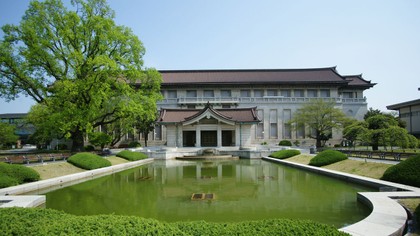
Tokyo National Museum (TNM) has the longest history of any museum in Japan. The Tokyo National Museum has two exhibition categories; one is regular exhibitions and the other is special exhibitions. The regular exhibitions consist of our own collection and works that have been trustfully on deposit. The objects on display are exchanged depending on the material and condition. Amongst all the exhibits, especially painting, calligraphy, textile and lacquerware are sensitive to the extent that they have to be exchanged every 4 to 8 weeks. Special exhibitions are large-scale exhibitions with fixed themes, which are held about 5 times a year. Depending on the theme, we gather exhibits from all over Japan, and from all over the world at the Tokyo National Museum.

Gourd-Shaped Sake Bottle with Circles, Jingdezhen ware, China, Ming dynasty, 17th century, Gift of Mr. Hirota Matsushige
Sake Cup Yellow glaze, Karatsu ware, Edo period, 17th century, Gift of Mr. Hirota Matsushige
This exhibition is related to the special exhibition "The Grand Universe of Hon'ami Kōetsu" at the Tokyo National Museum (at the Heiseikan, from January 16 to March 10, 2024). Focusing on the "tea bowl," a leading tool in one of Japan's most representative traditional cultures, "Chanoyu (Tea ceremony)," we will exhibit renowned bowls made in various regions of China, the Korean Peninsula, Southeast Asia, and Japan, mainly from our museum's collection.

In the Chanoyu (Tea ceremony), there are documents known as "chakai-ki" (tea collection records). These detail when, where, and by whom a gathering was held, as well as what utensils were used, and were meticulously recorded by tea practitioners of the past. Tracing these chakai-ki reveals that in the early 16th century, when the Chanoyu (Tea ceremony) began to become popular among merchants, monks, and warlords, tea bowls were freely chosen and used as part of the arrangement and presentation, not restricted to specific production areas or shapes. This was just before the procedures and etiquette of the Chanoyu (Tea ceremony) began to be formalized. Later, in the late 16th century, with the advent of Raku tea bowls made by the potter Chojiro, unique domestically produced tea bowls called "wamono chawan" were made in various regions, and people's appreciation of Chanoyu (Tea ceremony) bowls became richer and more complex.

In the newly renovated exhibition rooms of the main building, Room 4, in addition to the exhibition and lighting innovations that allow visitors to feel closer to the artworks, we have installed digital signage with images and videos that recreate tea gatherings in the actual tea house "Tengo-an" at the museum, introducing the charm and history of the Chanoyu (Tea ceremony) in a way that is more understandable to foreign tourists and younger generations. We hope you will appreciate the flexibility and discerning eye of the Japanese aesthetic sense through the nature of tea bowls during the heyday of the Chanoyu (Tea ceremony) in the 16th century.